
TIMIO Player review: screen-free audio for toddlers (vs Yoto and Toniebox)
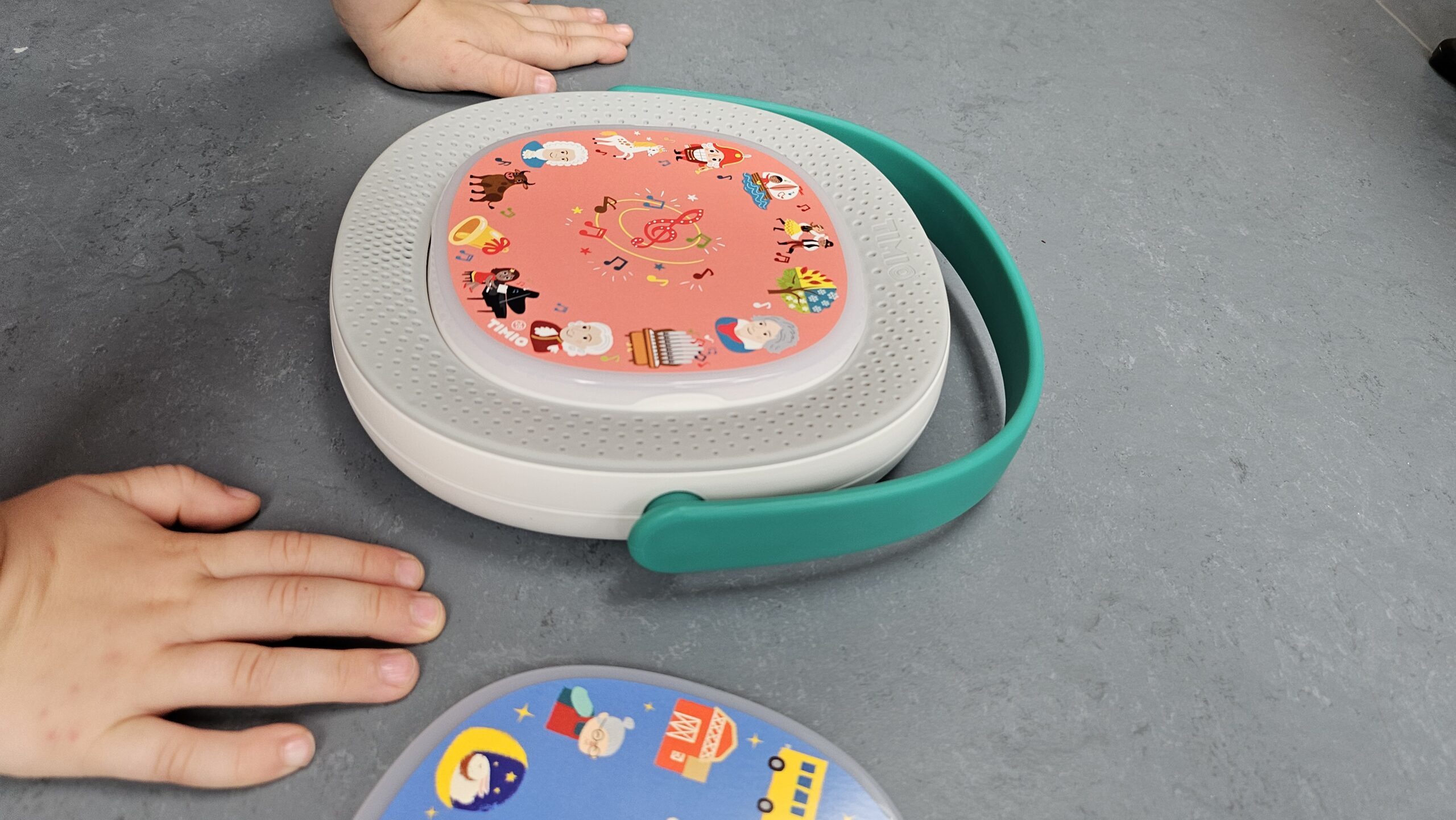
Looking for screen-free entertainment, but your toddler simply does not have the patience for long audio stories yet? In this review I share our experience with the TIMIO Player: an interactive audio player that gives instant payoff in the play area.
In short (~30 seconds)
- What: hands-on TIMIO Player review (discs, quiz mode, 8 languages) after home experience with toddler (2) and preschooler (4).
- For whom: impatient toddlers who want short clips; sibling split if you already have a Yoto.
- Cost: starter
€79; closed catalogue (€179 complete) vs Yoto MYO or pricey Tonies; see hidden-cost post. - Our take: TIMIO wins for the youngest; Yoto wins for longer stories and custom content.
My four-year-old has recently started inventing his own stories. Where that used to end with ‘Mum, I have a fun story, will you listen?’ we now make something more visual out of it. He wants to make things himself: pictures, books (Gemini Storybook), and recording sounds to play back on the Yoto Mini. He deliberately picks the sounds that match an action (think pillow fights or kicking a ball; calm play with a train set is not on the list). A really fun game, but there is one problem: his two-year-old brother has a completely different play style and we only have one Yoto Mini. The youngest wants to operate the Yoto himself too, and he refuses to play second fiddle. He understands perfectly after being told once how to slide a card into the player, but he simply does not have the patience yet for long, audio-only entertainment. He wants instant payoff, shorter clips, and something else to look at besides a single pixel icon.
That co-creation has rules: invented characters only in Gemini Storybook, no recognisable photos of the children, and no names in the cloud tied to their real identity. Recordings for homemade Yoto cards go to the cloud via an account; I do not put that in the same category as a talking teddy in the bedroom, but it is still personal data (voice, stories) leaving the house. The TIMIO does not upload anything; it runs offline on fixed discs.
So I looked into the TIMIO Player instead, even though that was not my plan at first. At around €79 it is not cheap, but I expect the youngest will get at least two years of use out of it. The content is a perfect fit for a kid his age.
Who got it first this time
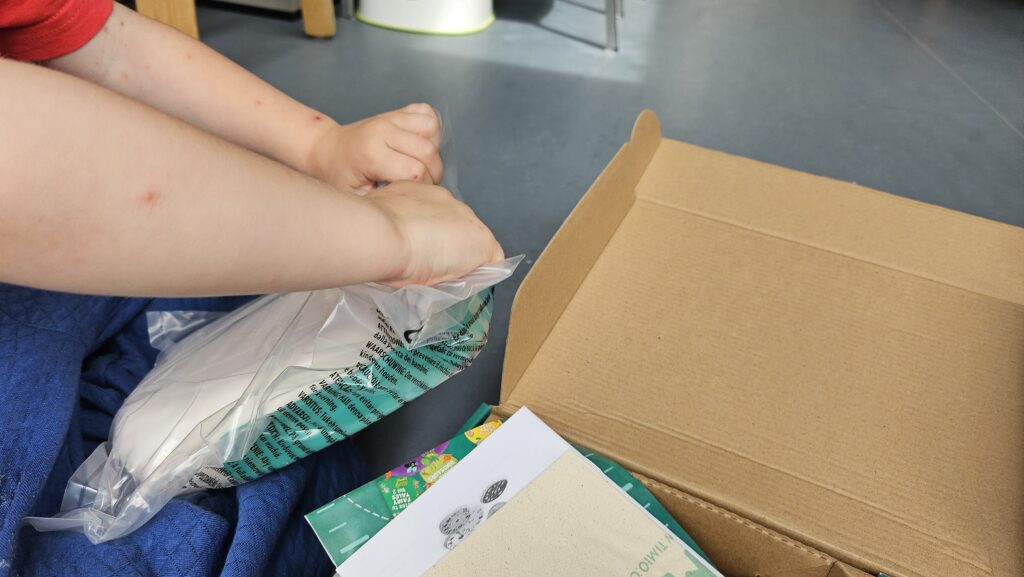
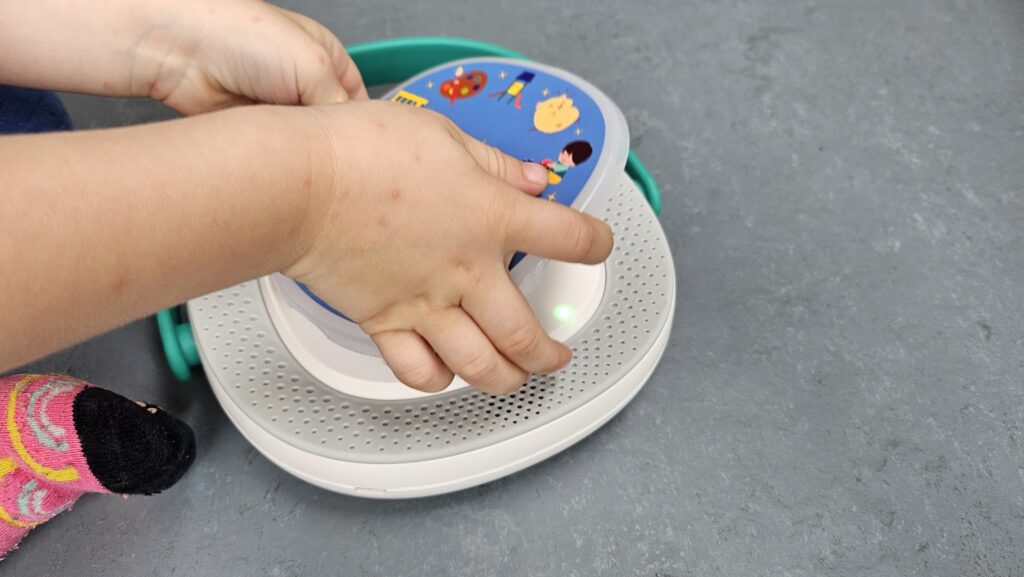
My four-year-old enthusiastically took the package from the postman and cut open the cardboard himself. ‘Wow, what’s inside?’ was the first thing he shouted when he saw the colourful TIMIO packaging. ‘A game?’ Then he spotted a car on the side: ‘A car, ohw.’ But curiosity instantly got the better of him: ‘Can I try this game?’ Where the youngest had claimed the Yoto Mini first a while back, the oldest was now the first to grab the TIMIO.
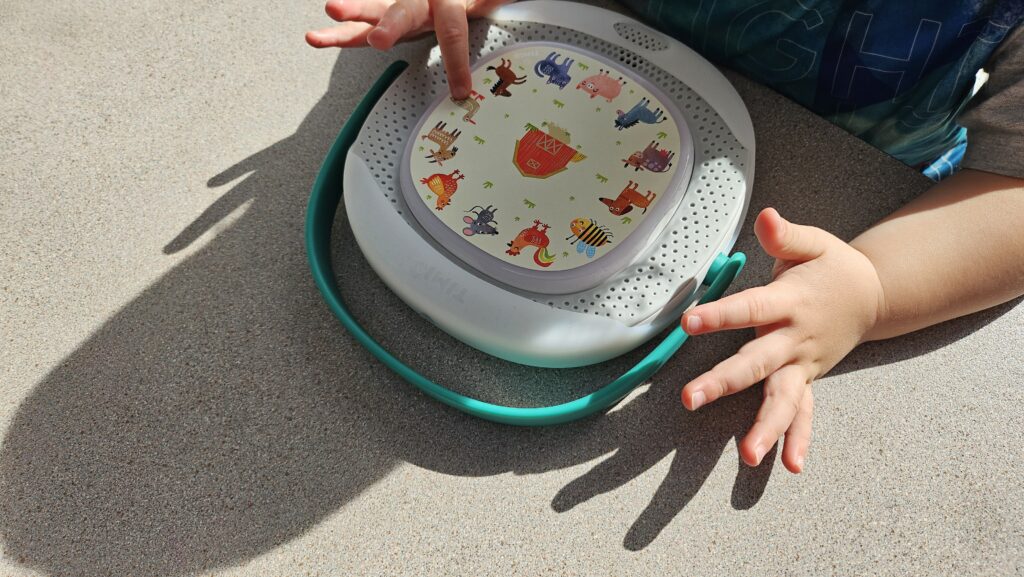
Without a single disc on it yet, he started pressing buttons as soon as he turned it on and had already found quiz mode. He placed the farm animals disc on top and the TIMIO immediately fired English questions at him: ‘Find the bee. Well done. Find the chicken. That’s correct.’
Since he’s only just starting to learn English, he needed a bit of help from me at first, but he picked it up surprisingly fast. I suspect that with the basic set in quiz mode he has a few hours of challenge, spread across several play sessions, before he has ‘finished’ the discs. Once he has learned the words, the TIMIO Player will lose its appeal.
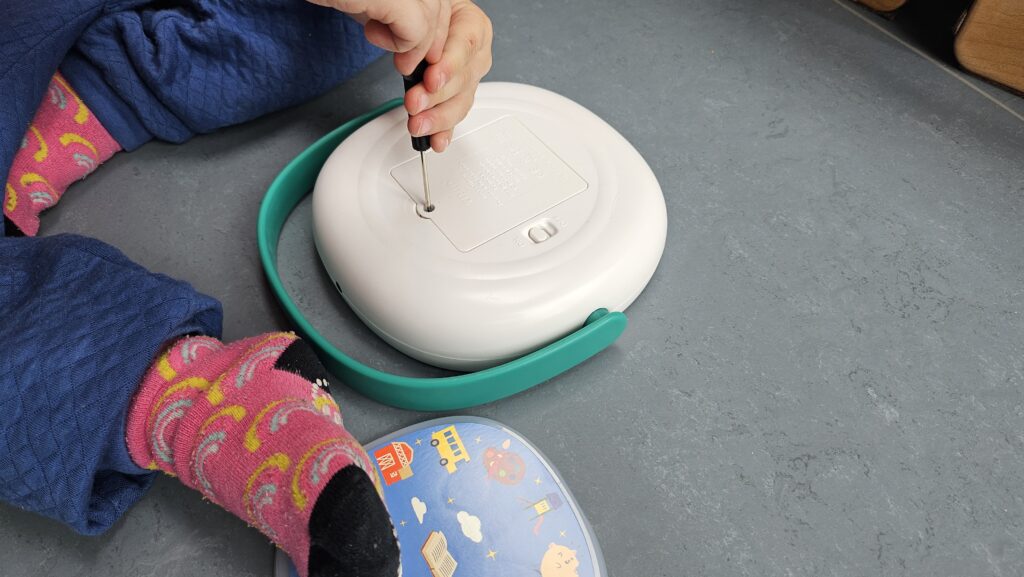
Well, as an audio player anyway. The TIMIO is also fun to open and close with a screwdriver. ;)
Short clips and an enthusiastic instructor
As soon as the youngest came home, his big brother immediately ran over to show him the new addition. ‘Look, this is how it works!’ The youngest watched attentively until of course he wanted to press buttons himself.
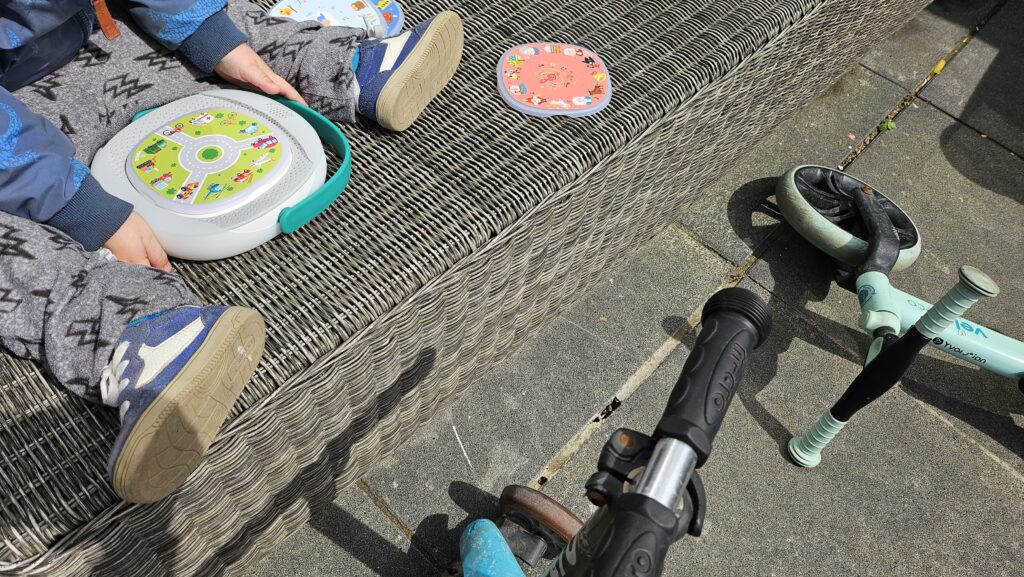
The system works with flat discs with pictures you can press to activate the underlying buttons on the player. Place the farm animals disc on the TIMIO, tap the bee, and you hear the word and the buzzing of a bee. For a two-year-old, the mode without questions is perfect for his attention span. The animals and vehicles were favourites from the start, and the classical music disc caught up after the first week. After three weeks he still does not care for the other two discs.
At first he did tend to go full DJ mode over those buttons; pressing in rapid succession so you only hear half words. But soon he was sitting attentively listening to the sounds for five minutes straight and calmly trying things out. With the animal sounds I regularly hear happy squeals and see a grin on his face.
My intention, by the way, was to offer one disc at a time, because otherwise he would be more busy swapping discs than engaging with the content. But reality quickly set in: he had already spotted the other discs on the kitchen island. However nice my plan was beforehand: it is his toy, so he is in charge.
A surprise lesson while I was cooking
Meanwhile I had started cooking, which never stays undisturbed for long. The oldest continued with the Yoto Mini. The youngest of course wanted that too, until he reconsidered and sat back down with the TIMIO (after running a lap around the kitchen island chasing his brother). Before long, both audio players were abandoned and they were kicking a beach ball and climbing over each other on the play bench. Good job, boys, burn off that energy, just do not kick the ball on top of the hot pans, okay?
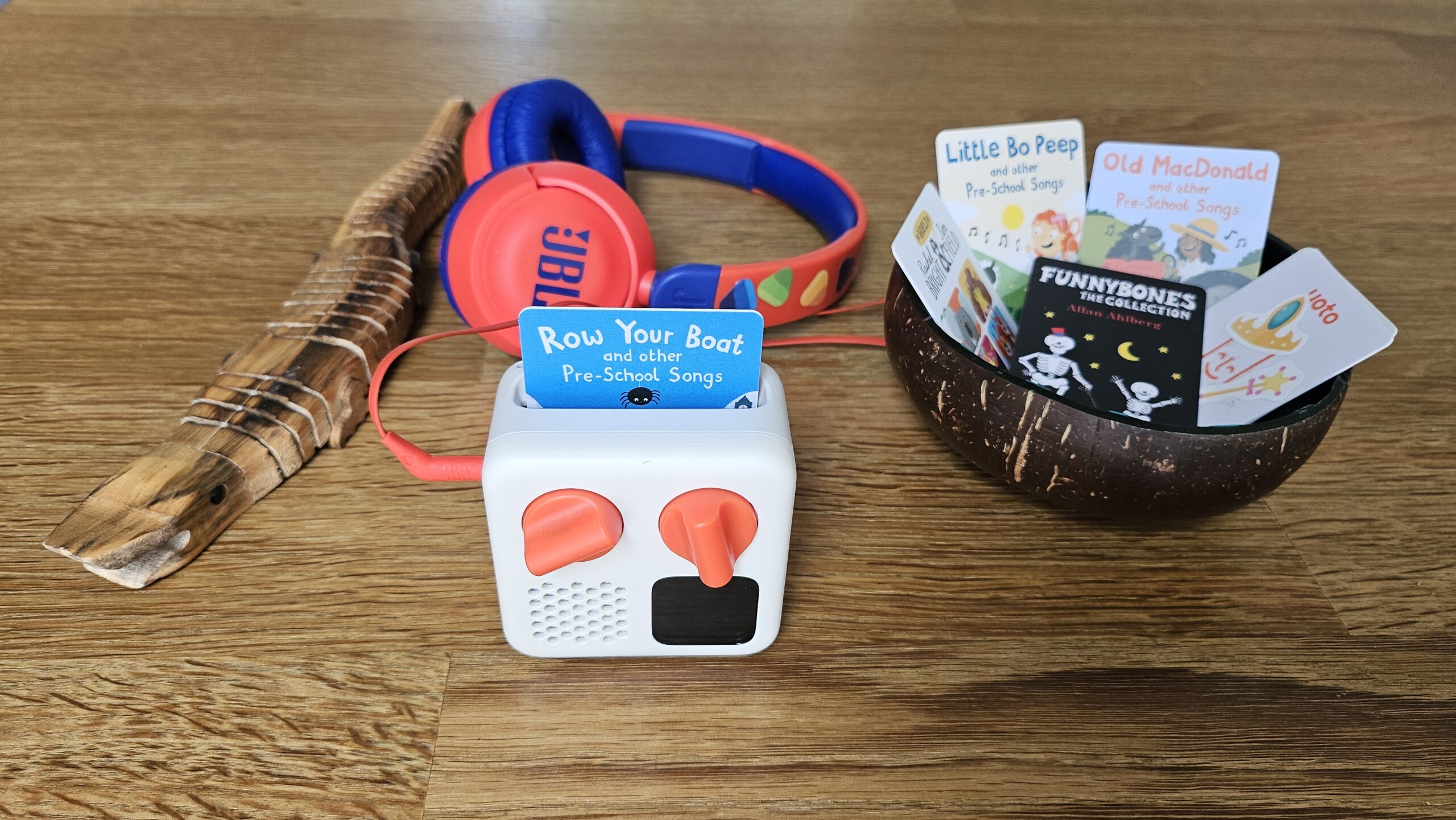
Meanwhile the Yoto sound kept playing in the background. The device had moved past the Funnybones story card and was now playing songs. The oldest stopped mid-kick and looked at the player in surprise. ‘Mum, that card is not even in there anymore?‘
Everything gets remembered
An incredibly sharp observation from my four-year-old. What he discovered in that moment is how cloud-cache works: the player remembers the downloaded audio even when you remove the physical trigger (the card). A magical moment for him, and a missed chance for me to explain how a computer can remember things it has ‘read’ before for a long time; I was cooking after all. And no, I do not try to turn everything into a learning moment. But sometimes he asks questions where the examples in my answer are still a bit abstract for him. So I try to name these situations so I can refer back to them more easily later.
Smart blocks and swarm robotics in the playroom
What I find fascinating about devices like the TIMIO and Yoto from my daily work with logic and AI is how they lay the groundwork for interacting with physical objects. Although the TIMIO is still a standalone, offline box for now, we are heading toward Swarm Robotics in the toy box.
You can best compare this to the development of the LEGO Smart Brick (launching in August): a technology where the building blocks themselves ‘know’ what you are building via sensors and logic. Instead of one central player producing all the sound, in the near future we will move toward sets of smart, physical blocks or discs that communicate wirelessly and locally with each other. Place an object with a ‘cow’ next to a block representing a ‘barn’ and both objects react to each other.
This mimics interaction in the real world. Think of a game where the TIMIO makes a sound and your child has to find the physical toy cow somewhere in the room. Or the player asks you to find friends for the cow or build a barn with Connetix or loose blocks. The audio player talks and reacts to what your child does, with sounds of happy or not so happy cows. If there is a ‘flood’ in the game, your child has to physically move the cow higher for example on top of the couch. Depending on the game you hear many different cow-related sounds, or new words are introduced in the same context (like cow pie, manure, or hay). Your interaction is no longer limited to pressing a disc and the small selection of sounds on it. By the way, I do not see this small selection as a downside for a two-year-old but rather as something positive.
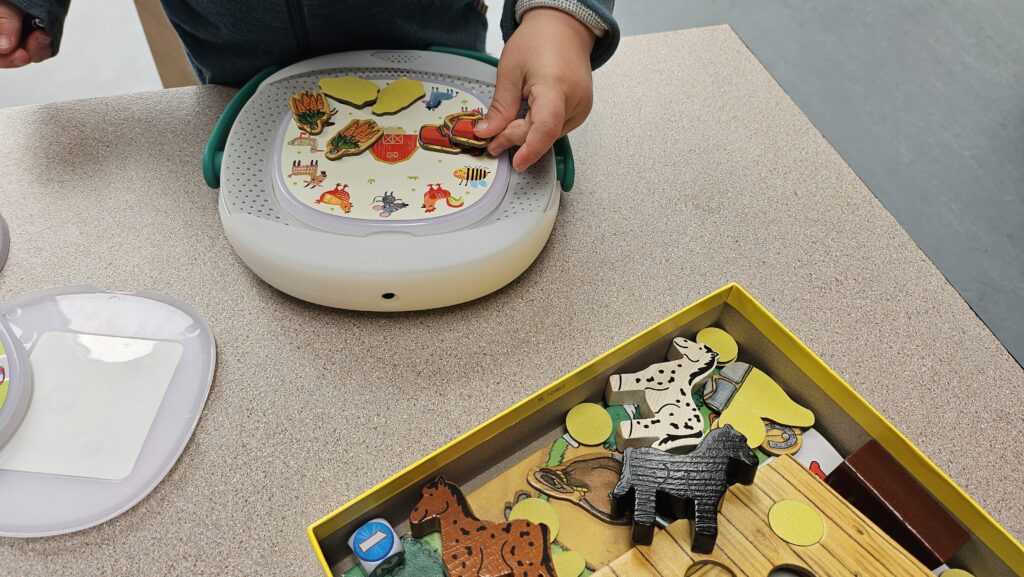
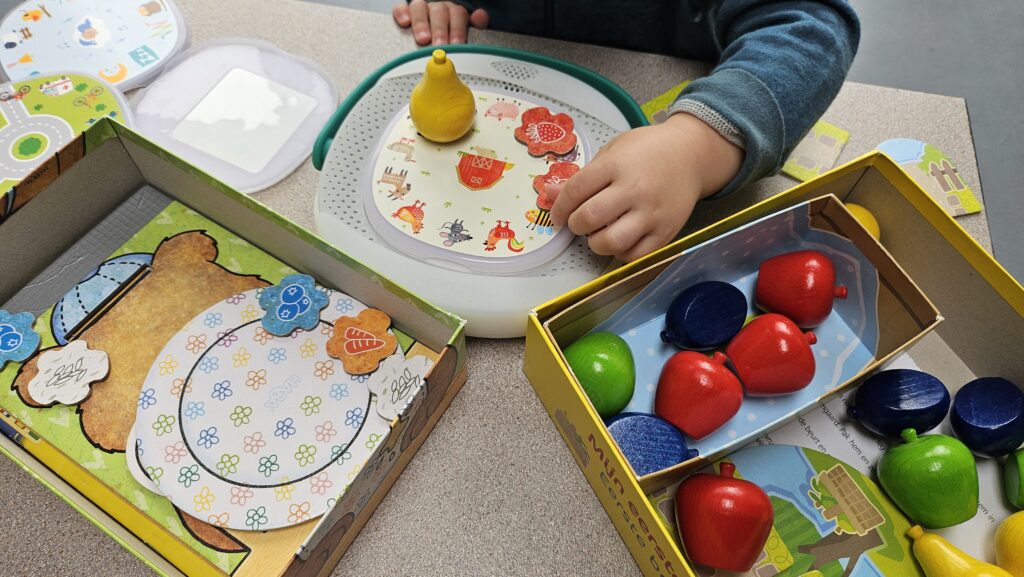
And the funny thing is: less than two days after I wrote this review, reality caught up with me again. My two-year-old and I had just finished a round of Hop in Galop. For those who do not know it: a game with wooden horses where you fill your feed bag on the way to the stable. Less than five minutes after we put the game away, he grabbed the TIMIO. He pressed the horse, heard the neighing, looked straight from the TIMIO to the games cupboard and demanded: ‘Carrot!’ After I handed him the box again he started feeding the wooden horses cardboard carrots and buckets of water.
Right after that he pointed at the games cupboard again and called ‘Raven’, so we got out My First Orchard. Then came ‘Strawberry. Bear’ (from Hungry as a Bear; a game that is now held together with duct tape). My toddler does not need swarm robotics at all for this. And now I wonder whether swarm robotics will actually be limiting, or whether such toys are more interesting for their educational value than for where they take free play.
Worth the price, or too limiting?
If we put the TIMIO purely side by side with the competition on price and function, the comparison is pretty straightforward. For around €79 you buy the Starter Kit with 5 discs. An expansion set of 5 new discs then costs about €20. If you want all the expansions, you can own the complete library for €179.
Compared to the Toniebox (where you keep buying individual figures at €15-€20 each and quickly spend hundreds of euros) this is budget-friendly. The Yoto is again somewhat cheaper in content costs if you make many cards yourself, but costs you a lot of time to build a good selection. The big downside of the TIMIO, however, is that it is a fully closed system. You cannot load your own MP3 files, record your own fairy tales, or program your own playlists. It lacks the flexibility to grow with an older child over the years. The TIMIO is an absolute recommendation as basic toy from a young age, but if you only start at 2.5 years old, the Yoto is smarter for the long term because of TIMIO’s closed system.
In the starter set you get Farm Animals, Classical Music, Vehicles, Lullabies, Bedtime Stories. I would use the lullabies more for a young toddler; during independent play this disc does not stay on long.
You can expand your collection with the following new sets:
- Set 1: Nursery Rhymes vol. 1, Wild Animals, Musical Instruments, Colours, Body Parts
- Set 2: Children’s Songs vol. 2, Sea Creatures, Numbers, Shapes, Fruit
- Set 3: Fairy Tales vol. 1, Alphabet A - L, Alphabet M - Z, Vegetables, Time
- Set 4: Children’s Songs vol. 3, Fairy Tales vol. 2, Fairy Tales vol. 3, Dinosaurs, Insects
- Christmas Songs
What I find disappointing myself is that there is no young-child versus older-child split. If your child already knows vegetables and fruit, those discs are no longer interesting in Dutch. And only these knowledge discs contain quiz questions. What is very fun again is the surprise factor a mixed set has for a young recipient. I think I may buy set 2 for our holiday; a bit depending on his development in the meantime and his biggest interests at that point.
Update late August 2026: Now that the youngest is almost 2.5, I see his interest in the Yoto Mini growing. Especially the song cards, the few fairy tales with the big bad wolf, and the card with my own recorded read-aloud stories. So I am no longer planning to buy an extra disc set.
TIMIO vs Yoto vs Toniebox
Looking for more than a review and want to choose between the three big screen-free players? Here is the tally after our home test. Full costs and safety are in the hidden-costs comparison.
| TIMIO | Yoto Mini | Toniebox | |
|---|---|---|---|
| Sweet spot age | Toddler (1.5-2.5): short sounds, big buttons | Preschooler (4+): longer stories, MYO | Broad 3–6; figures speak to the box |
| Rough costs (~2 years) | ~€180 (closed catalogue) | ~€300–400 (lots of MYO) | ~€500–700 (individual Tonies) |
| Custom content | No | Yes (MYO cards) | Creative Tonie (~€13) |
| Controls | Discs with pictures | Insert cards | Figures on the box |
| Two children | Second player (our case) | Swap cards / second Mini | Second box or Tonie theft |
| Bedroom (for us) | Green, but not night-time toy for toddler | Green from preschool age, volume low | Green, watch for scary stories |
On mic, wifi and account, TIMIO scores green in our bedroom check just like the Yoto Mini: no microphone in the player, no account, fully offline.

Frequently asked questions about TIMIO, Yoto and Toniebox
TIMIO or Yoto for a two-year-old? For us the TIMIO wins around age 2 because of the big pictures to press and the short sounds. He still does not have the patience for a long fairy tale on a card. After a few months with the TIMIO and Yoto Mini, he does reach for the Yoto more often because with Make Your Own (MYO) cards I can offer more variety than he gets from the TIMIO starter discs. I would not recommend buying a TIMIO for children over 2.5 years old.
TIMIO vs Yoto, which is cheaper over two years? TIMIO has a price ceiling (~€179 for the player with all discs). The Yoto gets cheaper if you fill lots of MYO cards yourself, but ready-made cards add up. The maths for both scenarios is in the hidden-costs post.
TIMIO vs Toniebox, which is better for young children? TIMIO and Toniebox are both physical and toddler-proof. I chose the TIMIO because of the lower start-up costs and the quiz discs; Toniebox stories are pricier per figure and the figures disappear into the toy drawer faster. If I had not already had a Yoto, which overlaps a lot functionally with the Toniebox, I think I would eventually pick a Toniebox over a TIMIO. Unless I was buying an audio player for an 18-month-old; for that age I find the TIMIO the best fit.
Can you record your own stories on the TIMIO? No. No MP3, no custom fairy tales. If you want that, Yoto with MYO cards is the route (or a Creative Tonie on Toniebox).
Does the TIMIO have a microphone? No. No camera, no app account. That stands in sharp contrast with AI teddies that can listen in permanently.
Is the TIMIO suitable for the bedroom? The TIMIO is certainly safe in the bedroom (offline, no microphone). At night it stays downstairs because I am not waiting for an audio drama while I sleep.
Playbook for the first play session
Want to introduce the TIMIO without it immediately becoming chaos of discs scattered everywhere? Here are three practical tips based on our first experiences:
- Introduce the discs one by one: When it is the two-year-old’s turn, deliberately lay out only one specific disc (for example the vehicles). If you offer the full stack of five right away, a toddler is more busy swapping discs than engaging with the theme content. Note: I failed at this because of my oldest’s spontaneity and the youngest’s eagle eyes knowing things lie on the kitchen island that he often wants but cannot always have. Of course, there’s nothing wrong with giving them the whole stack. But I clearly saw how he listened longer to each sound when only 1 or 2 discs were in front of him.
- Guide the first quizzes: Active quiz mode asks a lot of patience from a young child. It also takes a fair few seconds before the question starts, so on their own your child may not wait long enough and think no more sound is coming. Sit beside them the first few times. After that they quickly get the hang of it. For independent play I turn off the quiz function at the start (for a newly turned two-year-old).
- Use the multilingual options: Is your older child bored with the Dutch versions? Switch the player to English. Ideally you do not tell them what the English words mean, so your child can go on their own little voyage of discovery for the right translation. On the other hand, thinking along and translating at first fits well under playing together. My child simply wants the knowledge so he asks and expects an answer.
Finally I want to share this thought with you: Is the ultimate form of play not precisely that logical connections are not spoon-fed by a microchip? If we look at it critically, do we want toys to teach our child how the world works, or should imagination keep hacking that itself with passive toys in a world that is a big sandbox for them? Or does a reactive, interactive toy have something so magical that it actually sparks imagination and encourages fantasy?
Related articles
More articles on a similar topic.
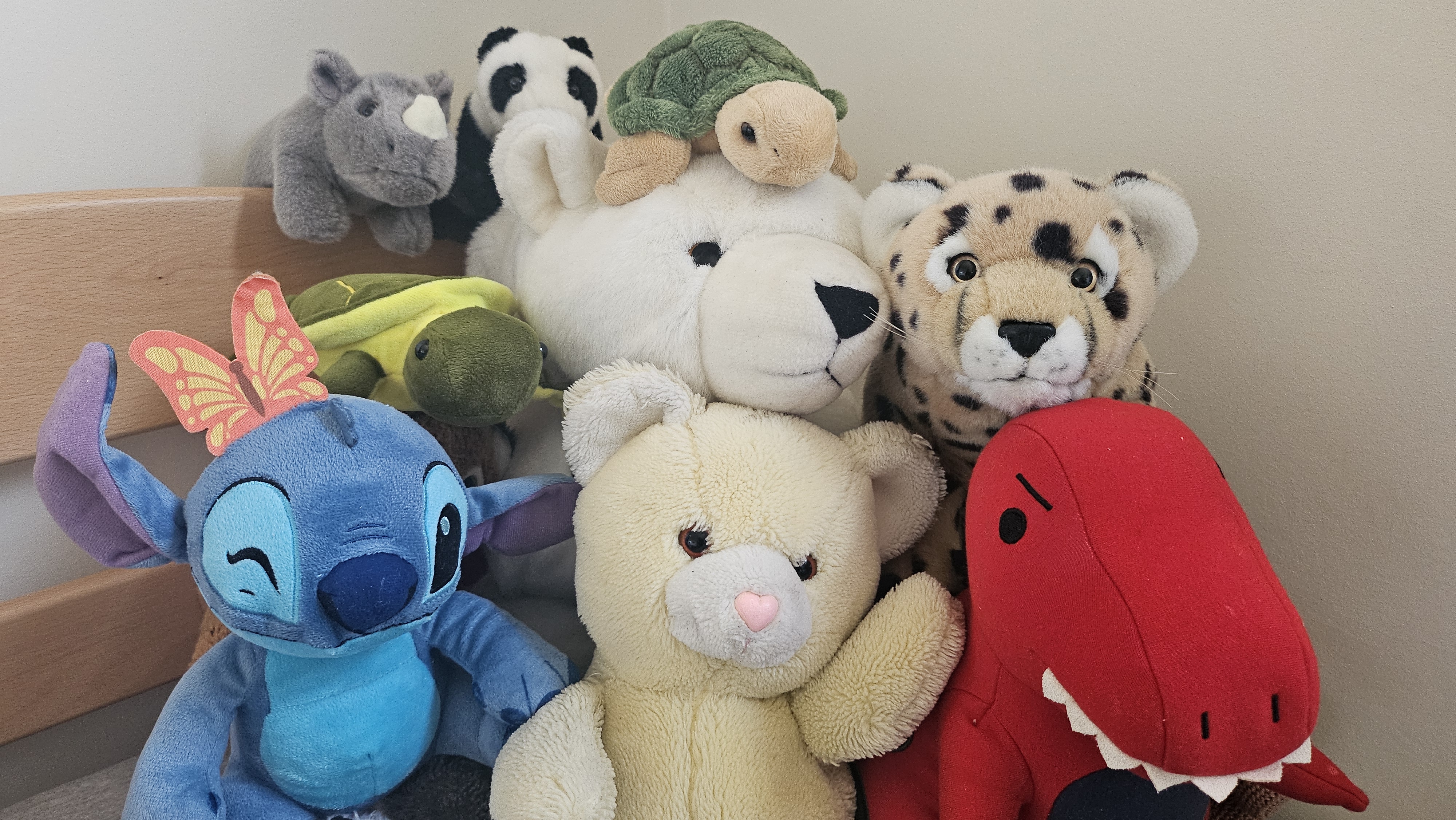
Buying an AI teddy? Five privacy questions before it enters the bedroom (2026)
Read more →
Comments (0)
No comments yet. Be the first!
Leave a comment
Comments are moderated before they appear.