
Toriki with a four-year-old: a board game that needs a companion app
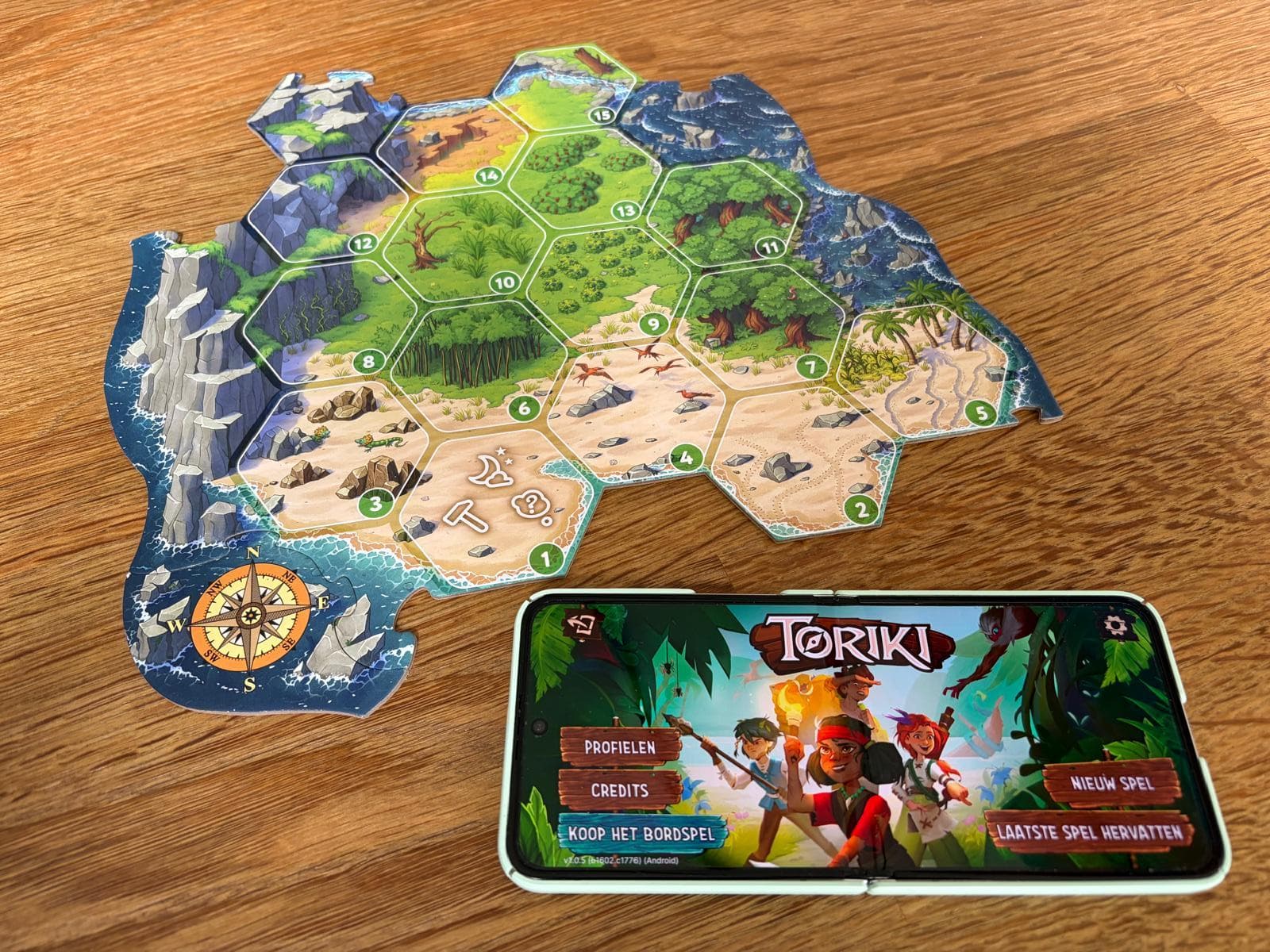
On the island of Toriki I read the app text aloud as if it were a proper adventure story. My four-year-old listens, watches the cards, and tells me where I am allowed to explore, which is how I have been attacked and poisoned three times already and he has not.
In short (~30 seconds)
- What: Toriki: The Castaway Island, a cooperative campaign board game with a required free companion app.
- For whom: the box says 8+. I play it with my four-year-old; I read and run the app. The toddler (2) sometimes watches from my lap.
- Honestly: not screen-free. The app sits beside the physical board and makes it richer.
A hybrid board game
You cannot play Toriki: The Castaway Island (Lucky Duck Games / DSV Games) without the app. It plays the soundscape, you tell it where you are, it describes what happens there, and you scan QR codes on object cards. The whole campaign runs about six to eight hours and you can split it into shorter sessions; the app remembers where you left off. We usually sit for about 45 minutes, though you could stop after a quarter of an hour and have everything ready again in a few minutes next time.
The app guides the game with short texts, sound, and sometimes an animation after a scan, while you keep looking at the cards and the board. The cardboard stays in charge. The digital layer adds tension and story, like a flavor engine.
You do not need a microphone, an account, or a subscription. You do need a phone with a camera on the table. That is hybrid play, not a screen-free alternative.
I accidentally bought the English edition. Switching the app to Dutch was no trouble.
| Age on the box | 8+ |
| Players | 1–4 co-op |
| Session | ~15–30 min per “day” in the campaign; we often play about 45 minutes |
| App | Free (iOS / Android); required |
| Price in NL | €30-35 |
| Reset | Campaign can be reset; the wildlife booklet is one-use (PDF available for later plays) |
At the table
Our setup is asymmetric, but not in the same way as asymmetric co-op with a toddler and a preschooler, where both children have a physical role. Here there is really only one and a half players. My preschooler chooses for himself, and half the time for me as well, which I let happen. I am the voice of the island and I run the app, help with words he does not know yet, and ask things like ‘What do we need to make that?’ or ‘What could we gather on this tile?’ He often knows the answers. He just does not ask the question himself yet.
When the app describes what we find, I read it a little slower or more dramatically, and he often wants me to explore wherever danger might be.
He is determined to craft everything, and halfway through a day he runs back to camp even though you return there automatically at night without spending food tokens that are still scarce at the start. Strategically messy, otherwise completely reasonable. We are not clever about sharing items either, because he has favourites that do not always match what he wants to do that day, and I sometimes have to negotiate hard. That is fine. It is a co-op with no time limit. You cannot lose.
I am the unlucky one who gets attacked and poisoned in places he did not even want to go, which he finds very funny. The consequences are gentle and you recover. Words come up that he has not heard on TV or in picture books: flint, gunpowder, and other survival-story materials. As you play you unlock extra parts of the island, camp upgrades, and information.
The cards I mixed up
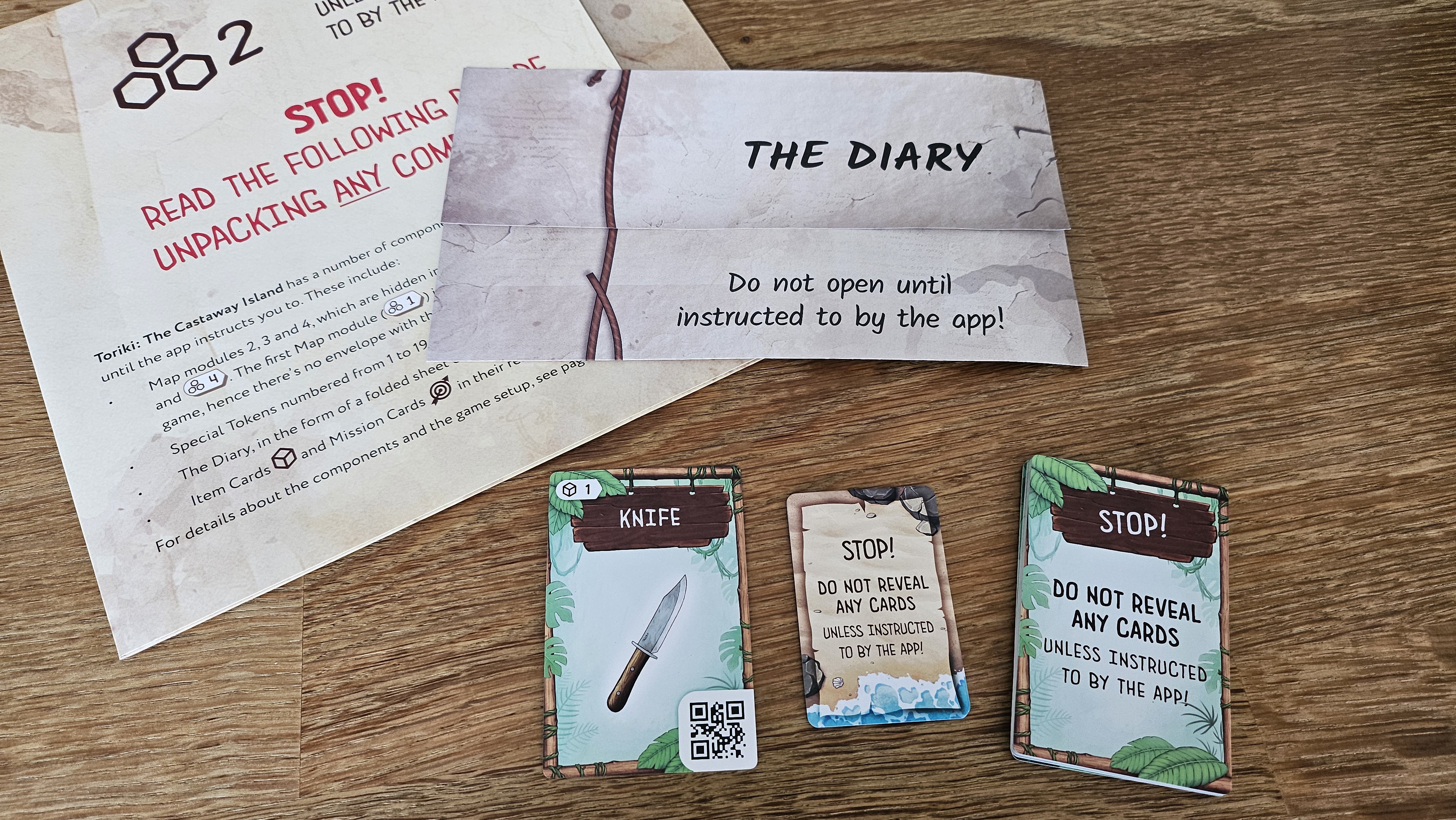
In the first hour I confused tiles you have to earn with mission cards you work towards. That is how we saw a raft picture earlier than we were meant to, and I could easily ask: ‘What do we need to build that?’ A few steps became easier than intended, until the second session, when he asked when we would finally get something from the stack of small cards. Oops.
As a parent you do not want to spoil the story by accident, and with a young player it is tempting to steer too much. I stay in the background where I can, but I do ask leading questions when I think he cannot get there on his own yet.
Why a four-year-old can play this
The box says 8+, and that is fair if you expect children to read the app themselves and play strategically. My four-year-old does not do that, but he still has a fantastic adventure. Making fire, a bow and arrow, or combining hooks and vines into something useful is not a lesson for him. It is a discovery. The wow moment is when he realises we can make something from stuff we just gathered, after which we scan the QR code and wait to see what the animation does. An eight-year-old would find those first crafts easy and obvious, I think. At four they are still a surprise.
Some missions are puzzles for me too, because you do not always guess right away where to find certain materials or what you still need. The app nudges you and we never get truly stuck. For adults on their own it would be too simple. With him it feels like an adventure, partly because he comes up with solutions I had not thought of. Sometimes he takes an illogical path and burns through all our precious food by running back and forth, which means he gathers something earlier than we need it in the game.
What he practises without noticing is thinking ahead: gather resources first, then combine them, and try different mixes to see if they pay off. Between four and eight he would learn those steps through building, craft games, or cooking as well. Here they sit inside a story.
When we have earned a tile, he turns away from me so he can look at it alone and first. I see him light up like that at least twenty times in the game.
The last coin
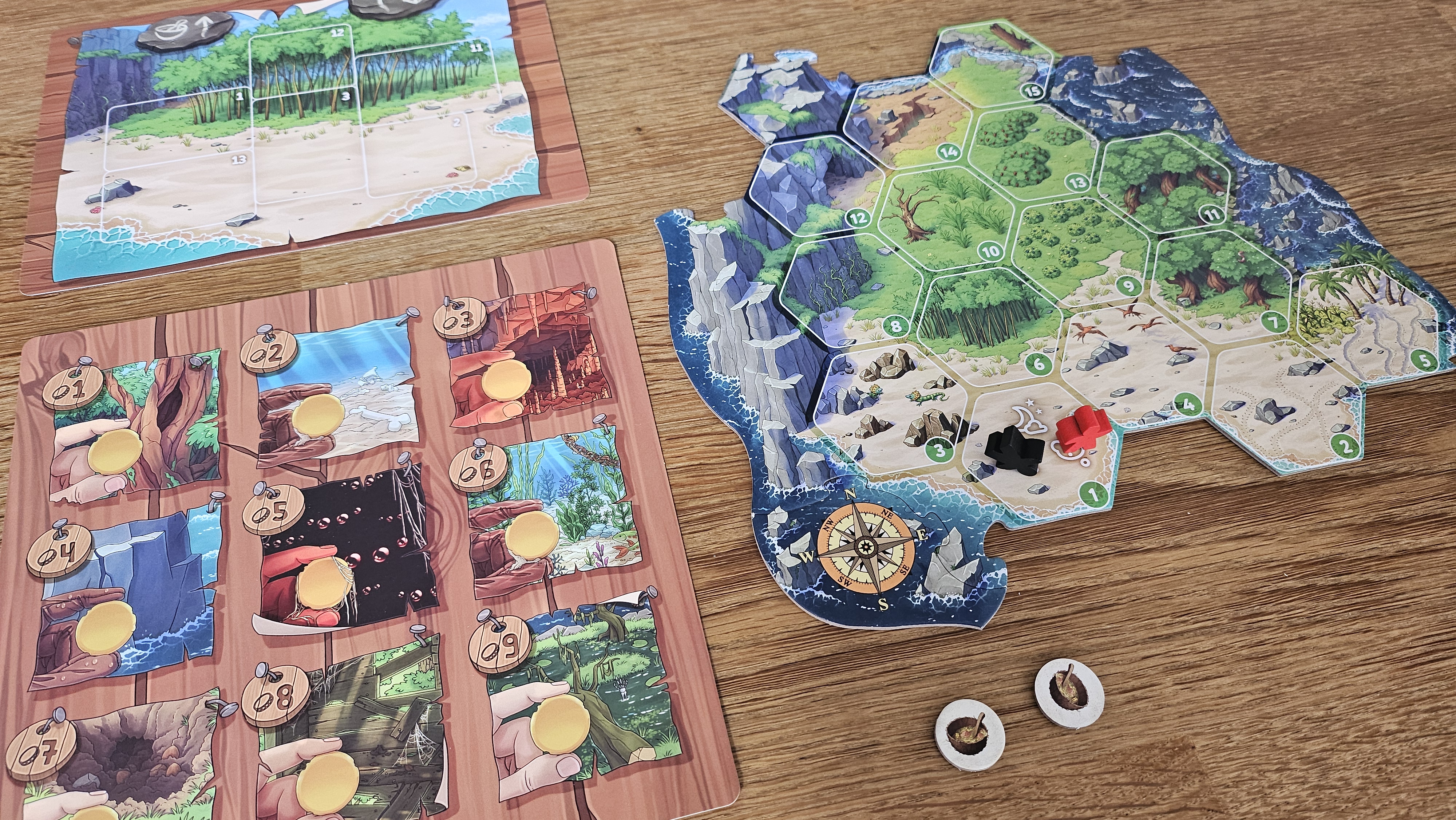
You can stretch the endgame of Toriki as long as you like, because the island does not close just because you think you are done. There is often still something left: an achievement, an item you have not crafted yet, or that one coin still hidden.
At one point we had eight of the nine coins, and in my head that was a solid score. We could try for the ninth again in a year. Let’s leave the island, I thought, and see how it ends. I was curious about the wrap-up and a bit tired of searching.
He was not. He dug his heels in about collecting every coin and refused to leave without the last one from the treasure chest. He does not play the island as a story that is allowed to finish. He plays it as a board game you keep coming back to.
The game allows both. Staying is not punished and leaving is not either. So we stayed, because his treasure was not finished, and the ending could wait. Other board games have caught his interest since, and I wonder whether we will see the ending this year. Next time we might start over.
When the toddler watches
My oldest wants to keep going day after day while his brother sleeps. Sometimes after his nap the toddler sits on my lap and taps the phone, which he likes and I like less, because it all goes a bit too fast and I cannot talk through the oldest’s plans as well. That is why I try to keep Toriki one-on-one.
For more than one age
Children over eight can play this board game without parents and take the expedition-leader role themselves. With a four-year-old you take on more as the adult. I am curious how the dynamic will change when his brother joins in a year or two.
With older children I think you play Toriki once and then pass it on to another family. I expect to play it at least three times: now, again when the youngest is four as well, and once more when they are both around that 8+ line and the details have faded.
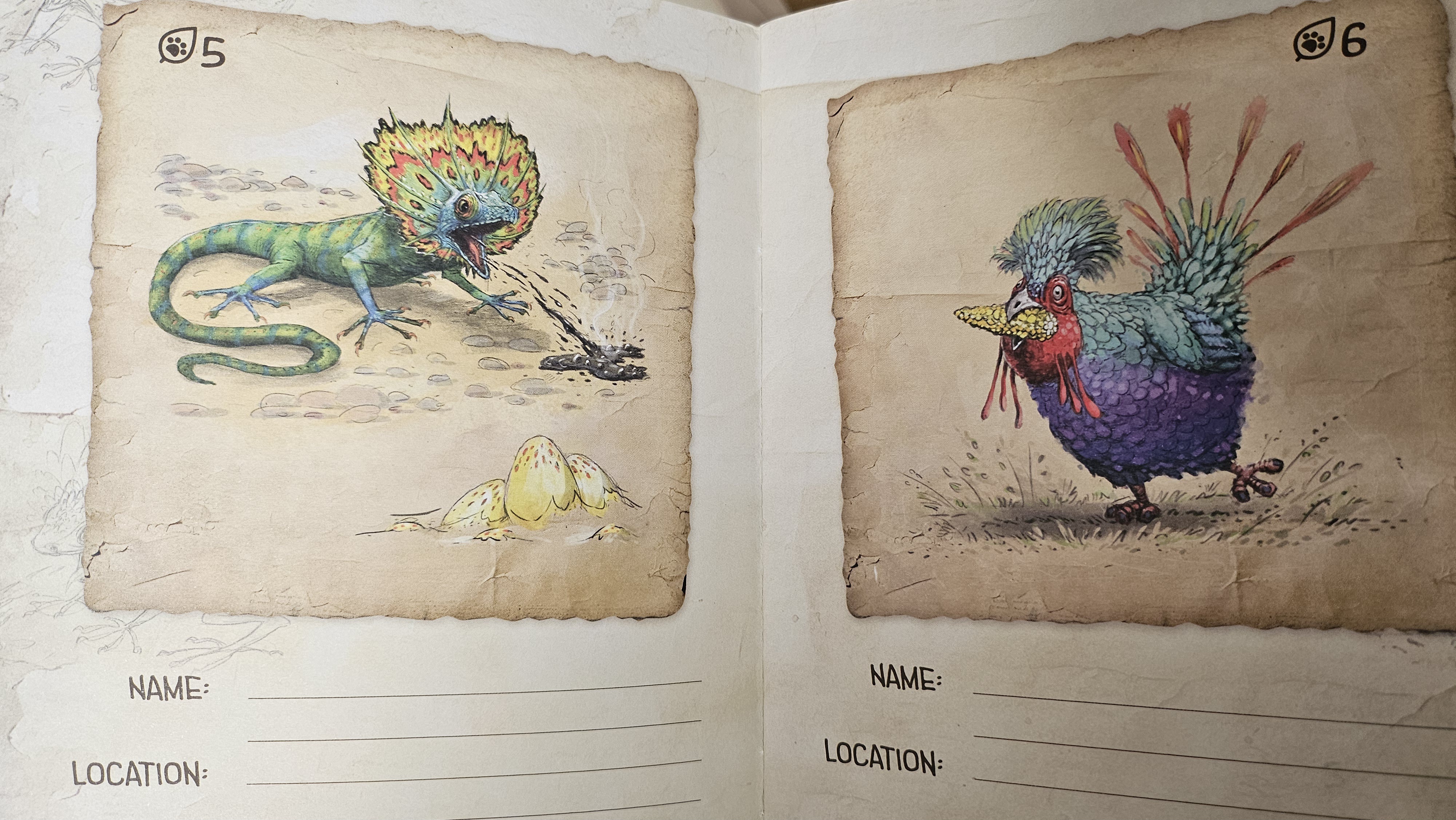
The pretty coloured wildlife booklet can only be used once. The publisher does supply a printable PDF for other sessions.
Younger on the island
Toriki is a lovely adventure to share with your children, and not a game I would play with adults only. The solutions are too easy for that, which does not mean I never have to try a few things before I find the answer. We had a good few weeks with it. Worth trying if your preschooler can already stay focused for 30 to 45 minutes.
Related articles
More articles on a similar topic.
Buying an AI teddy? Five privacy questions before it enters the bedroom (2026)
Read more →Comments (0)
No comments yet. Be the first!
Leave a comment
Comments are moderated before they appear.