
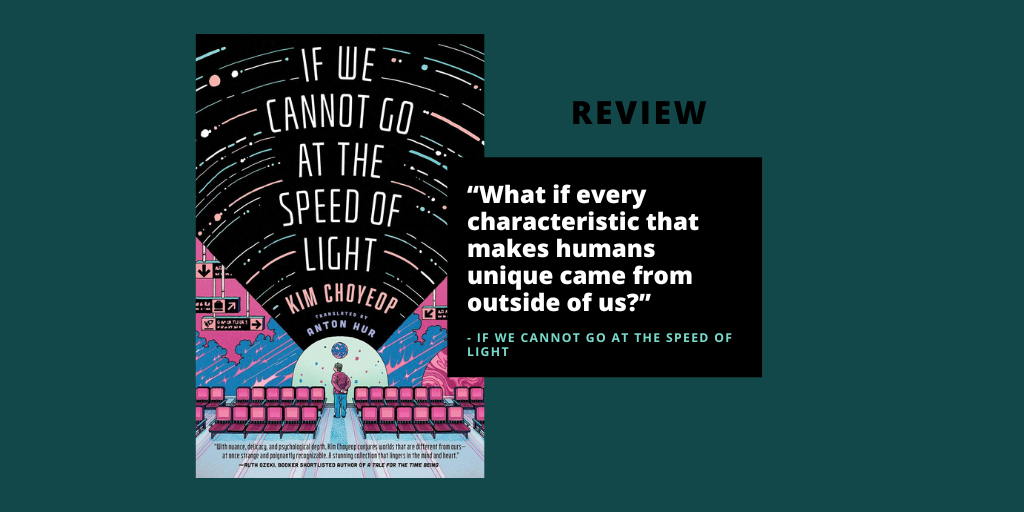
Review: If We Cannot Go at the Speed of Light by Kim Cho-yeop
A universal translation machine produces remarkable results the moment someone points it at a baby. Not because the device is broken, but because the thoughts rolling out of it do not sound like they come from an infant.
Setting: South Korea as the point of departure, and mostly outer space from there
In short (~30 seconds)
- What: seven science fiction stories by Kim Cho-yeop, translated into English for the first time by Anton Hur.
- Verdict: ★★★★☆
- Strongest: Pilgrims, The Symbiosis Theory and Archival Loss.
- Weakest: the title story, too short and too much like a report to get attached to the protagonists.
- For whom: readers who would rather leave with a good question than a tidy answer.
I rarely read science fiction to find out how it ends. I read it because I want to ponder deep questions that I do not encounter in everyday life. This collection is unusually good at that. The stories show you just enough of a larger world and then stop, at precisely the moment you would want to keep reading. What remains is that one open question.
Kim Cho-yeop takes her science seriously without burying you in it. She sets down a hypothesis, lets people walk around inside it, and trusts you to do the rest.
Seven stories, seven questions
| Story | The question that lingers |
|---|---|
| The Symbiosis Theory | What if everything that makes us human comes from outside ourselves? |
| Spectrum | When did you become the person you are now, and what triggered it? |
| If We Cannot Go at the Speed of Light | How long do you keep waiting for something that probably will not come? |
| The Materiality of Emotions | Would you want to be able to hold your feelings and dose them? |
| Archival Loss | Who owns your data once you are gone, and for how long? |
| Pilgrims | Who gets to be born, and who decides that? |
| My Space Hero | How well did you really know someone, and do you notice that too late? |
What if humanity comes from outside?
The opening story (The Symbiosis Theory) begins as detached as a research report, which does not exactly make for comfortable reading. And yet you want to know what is going on just as badly as the characters do, so before you notice it you have been pulled in.
The moment the behaviour of infants upends everything the researchers thought they knew, I was sold. If I assume my children are having more existential thoughts right now than I am, does that change the way I look at them? The classic conversation is about nature versus nurture. This story asks the more dangerous follow-up question: who is doing that nurturing, exactly?
There the book touches on something I deal with both professionally and at home, without meaning to. It weighs up, with very little drama, what a robot can do as a babysitter or a teacher and what it cannot. I catch myself making that same calculation about a talking teddy’s access to the bedroom. Kim Cho-yeop does not write characters who stay with you, and there is barely any conflict. What she does write is a thought you get to finish yourself.
Who owns your data once you are gone?
Archival Loss was the story that kept me thinking the longest. The main character treats fragments of data as the people they once represented, and that is exactly where things go wrong when no legislation or decent ethical thinking exists around it yet. Who owns someone’s data after their death, and for how long? What happens to a mind that lives on somewhere without a body? It gives lost and unreachable data a whole extra layer of meaning.
Stories like this land very differently now than they would have twenty-five years ago. Back then it was speculation; now it is a setting in an account. What stayed with me longest is whether a snapshot of someone you have lost is a comfort or makes it worse. You can keep visiting, but that person does not evolve with you, never changes their mind, and never gets older than the day the recording stopped.
Who gets to be born
Pilgrims is the best-constructed story in the collection and also the most uncomfortable. It is about embryo selection, and therefore about who gets to be born, but it never sinks into a debate. You are handed a choice: a safe place without highs or lows, or ordinary Earth with all the good and bad that happens there.
It looks like an easy choice because we are not actually facing it. But a sheltered community of people created through embryo selection is not impossible in the world we live in now. Underneath sits a question about the power of a handful of people to change humanity, and whether that could be a job for all of us instead. It is an origin story that takes its time.
Where it works less well
The title story is, of all things, the one that moved me least. It reads too much like an account and too little like a story in which something new still happens along the way. Before I was emotionally invested, it was over.
Spectrum has the opposite problem. Its world, with a written language that looks nothing like ours, is so interesting that I wanted to walk around in it far longer. The story is simply too short to bring that world to life. A luxury problem, but a shame all the same.
And The Materiality of Emotions leans on an idea I summarised in my notes as the feeling that all your emotions are within reach and you know you can control them. The essence of materialism, but in a positive sense: making intangible feelings tangible and giving them room.
The distance you do not cross
Almost every story is about a distance that is too great, even with whatever technology happens to exist in that universe. Sometimes that distance is space or time; more often it is the inability to understand why someone did what they did. It also feels like a quiet betrayal by the people closest to you, who apparently do not see you as someone worth sharing their thoughts and experiences with. I felt that most in My Space Hero, but certainly also in Spectrum and The Symbiosis Theory.
What I find impressive is that the longing in these stories transfers to you as a reader. Characters want a look at the other side of the universe. Meanwhile you want to know what happened to that one character who is discussed but barely appears. Those two questions are the same question: what is humanity still going to live through? That is how stories set in the future get tied to a past that, for us, still lies ahead.
Kim Cho-yeop names it herself in her acknowledgements. She loves stories about people who search, explore, and try to grasp the incomprehensible. That is probably exactly why this collection suits me, because it is also what I look for in books and where my interest in AI and future tech comes from.
Final thoughts
★★★★☆
A collection to read slowly, with a longing for something you have never seen with your own eyes. All seven stories leave something behind, but which ones do that for you depends on what you happen to be dwelling on at this point in your life. For me it was the stories about the data of the dead and the question of who gets to be born and who raises the newborn. In a few years it might be completely different ones.
Read it if you like science fiction that hands you a question instead of an answer.
Interested?
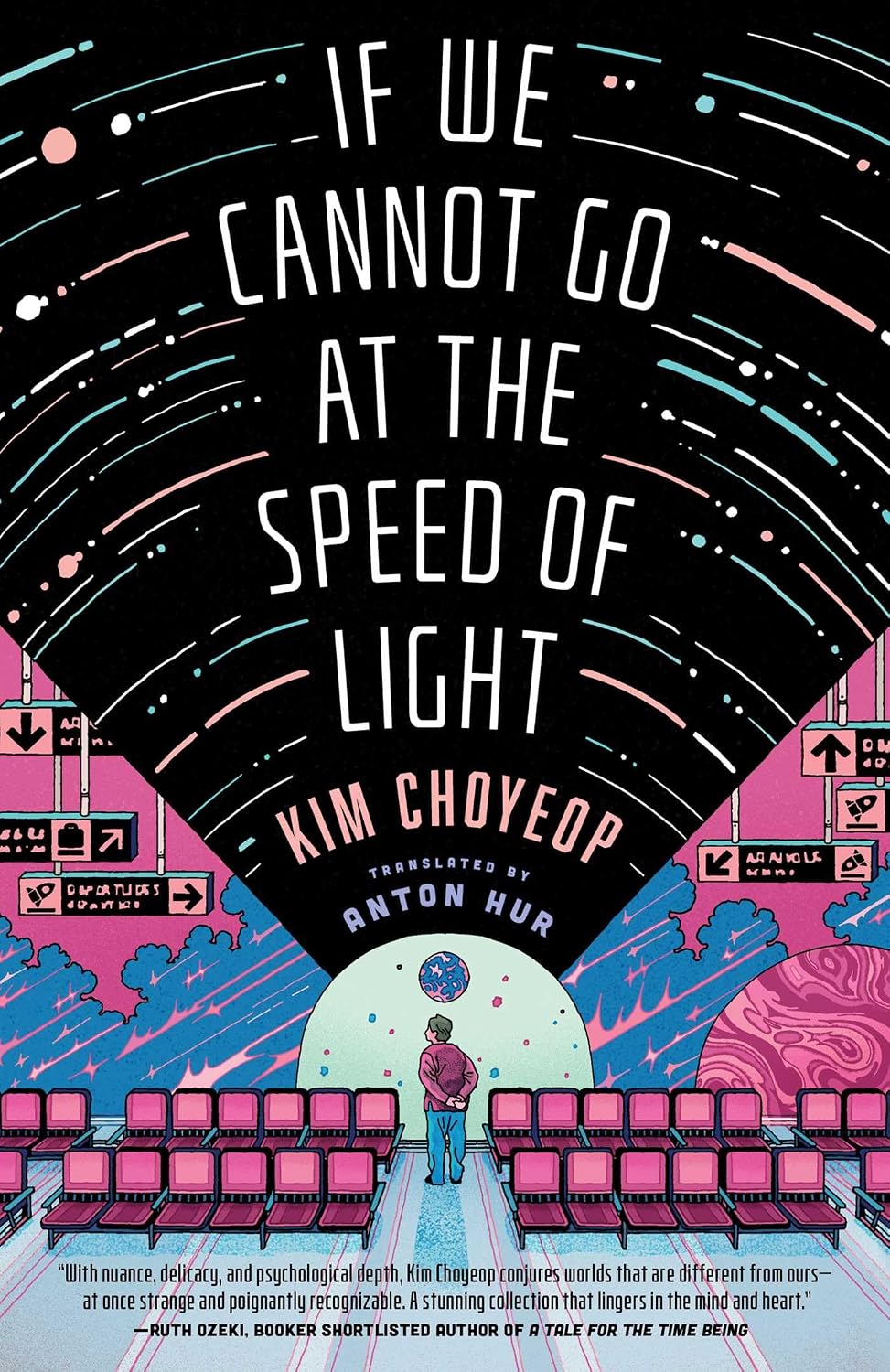
Kim Cho-yeop — If We Cannot Go at the Speed of Light
Blurb
- Meet the alien species that put the humanity into human beings
- Discover the fate of Slefonia III once warp travel became obsolete
- Visit the Mind Library to commune with the dead
- Purchase sadness as a stone and anger as a paperweight
Kim Choyeop became an instant literary sensation in Korea with her debut short story collection. Each of these bitesize speculative masterpieces represents a journey into the unknown, guided by a writer blessed with a boundless imagination.
From alternative futures to distant alien planets, in the company of scientists, space explorers and ordinary citizens in extraordinary situations, she revels in making the impossible seem not only possible but somehow inevitable.
Traversing the bounds of imagination with an ethereal incisiveness, her stories dismantle the borders between normal and abnormal, material and abstract, earthly and otherworldly. With unforgettable inventiveness and pathos, If We Cannot Go at the Speed of Light heralds the arrival of an essential voice in contemporary fiction.
ISBN
US (hardcover): 9781668049457
UK (paperback): 9781529447613
About the author and the translator
Kim Cho-yeop studied biochemistry and made her debut in 2017. This collection came out in Korea in 2019 and made her, within a short time, one of the best-known names in Korean science fiction. This is her English-language debut.
Anton Hur translates Korean literature into English and has been longlisted twice for the International Booker Prize, including for Cursed Bunny by Bora Chung. In his introduction he explains what he thinks sets Korean science fiction apart: attention to the forgotten edges of existence, corners of the universe that exist only briefly and still contain entire worlds.
Related articles
More articles on a similar topic.
Comments (0)
No comments yet. Be the first!
Leave a comment
Comments are moderated before they appear.